On October 27, Dr Yik Teo, Director of Global Engagement and Partnerships at The University of Newcastle, Australia, led a delegation to visit our university. Zhao Shuangliang, Member of the Standing Committee of the University Party Committee and Vice President, met with the visitors.
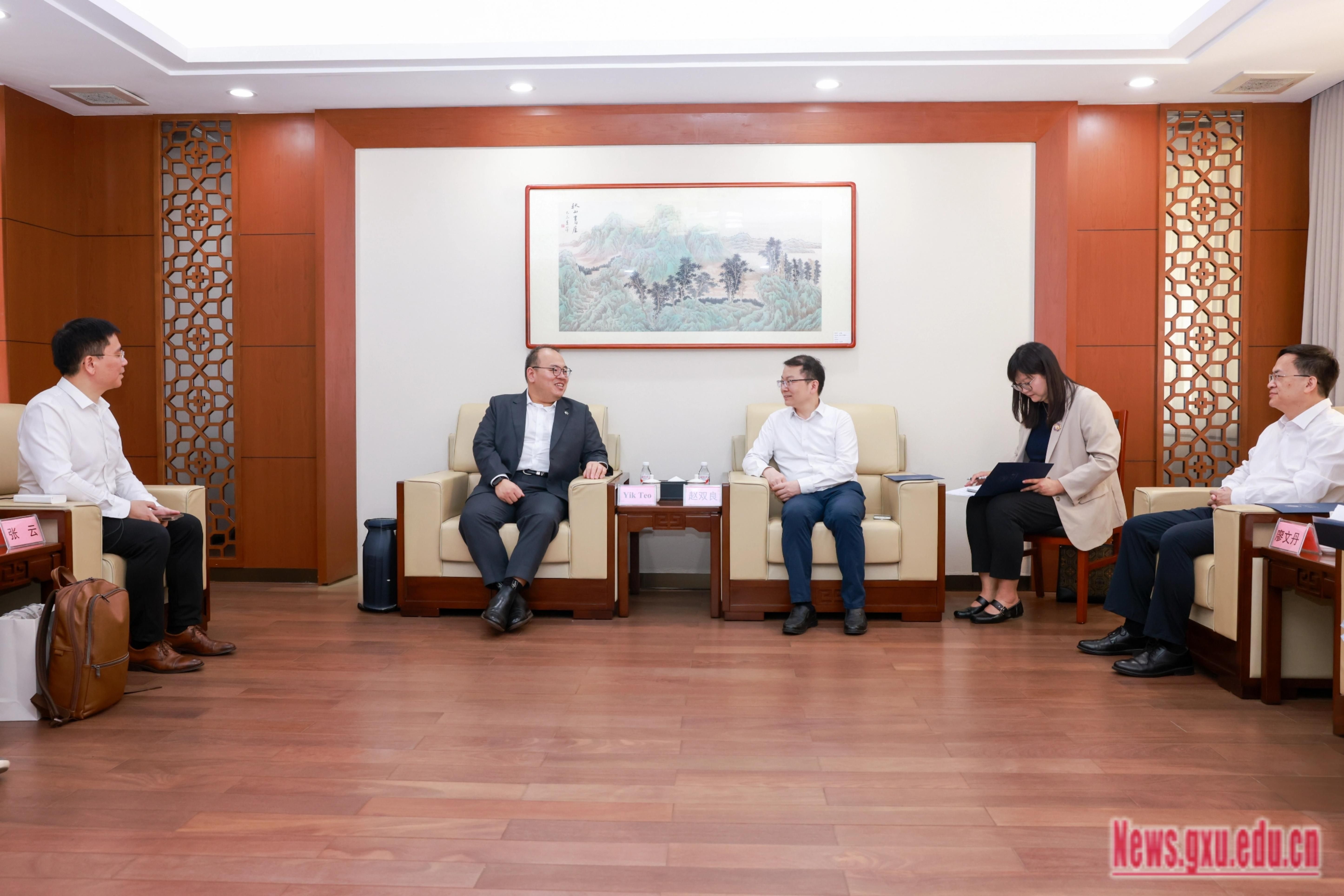
Zhao Shuangliang extended a warm welcome to the delegation and briefed them on the university’s history, disciplinary layout and scale of operation. He noted that the university boasts distinctive strengths in disciplines including Mining Engineering, Materials Science and Engineering, Civil Engineering and Business Administration. Endowed with rich mineral resources, Guangxi enjoys a high degree of alignment with the University of Newcastle’s flagship disciplines, laying a solid foundation for international collaboration between the two institutions. He expressed the hope that this visit will serve as an opportunity to elevate exchanges from individual faculty interactions to institutional, university-level cooperation. The two sides may explore joint education models such as “4+1” and “3+1” programmes for multi-level joint talent training covering undergraduate, master’s and doctoral students, expand channels for faculty and student exchanges as well as collaborative research and innovation, foster new cooperation growth areas based on their respective strong disciplines, and jointly boost the international development of both universities.
Yik Teo remarked that the University of Newcastle enjoys prominent international influence in mineral and mining engineering, with robust strengths in materials and automation engineering. The university also has practical experience in delivering dual-degree joint training programmes with overseas higher education institutions. He pointed out that the two universities each have their own disciplinary strengths and boast broad prospects for cooperation. He expressed anticipation that both sides could build on their disciplinary features to jointly explore cooperation avenues including multi-level joint training, dual-degree programmes, and faculty and student exchange schemes. The two parties may collaboratively analyse challenges encountered in implementing initiatives such as international accreditation for engineering majors, push relevant departments to strengthen communication and coordination, and work together to deliver tangible outcomes from cooperation projects.
At the symposium, the two sides held in-depth discussions on Sino-foreign cooperative education models, student exchange programmes, joint research initiatives, reciprocal appointment of supervisors, and academic seminars and exchanges.
During the visit, the delegation toured the Large-Scale Structural Testing Research Platform of Civil Engineering and the School of Resources, Environment and Materials of our university, and learned in detail about the platform development, disciplinary progress and research achievements of the university in scientific research on major engineering structures, exploitation and utilization of mineral resources, and R&D of advanced materials.
Heads of the Graduate School, Office of International Cooperation and Exchanges, School of Civil Engineering and Architecture, School of Resources, Environment and Materials, School of Business and School of Economics of our university attended the symposium.

 Home
>
News & Events
>
News


