The Nature Index has recently released its latest data on its official website. For the statistical period from 1 July 2025 to 30 June 2026, GXU ranks 98th among universities worldwide and 47th among universities in the Chinese mainland, entering the global top 100 for the first time. Compared with the previous period (1 April 2024 to 31 March 2025), GXU moved up 100 places in the global ranking, as its high-quality research output continued to climb. This progress is the natural result of the University's long-standing commitment to organized research and to dedicated basic research.
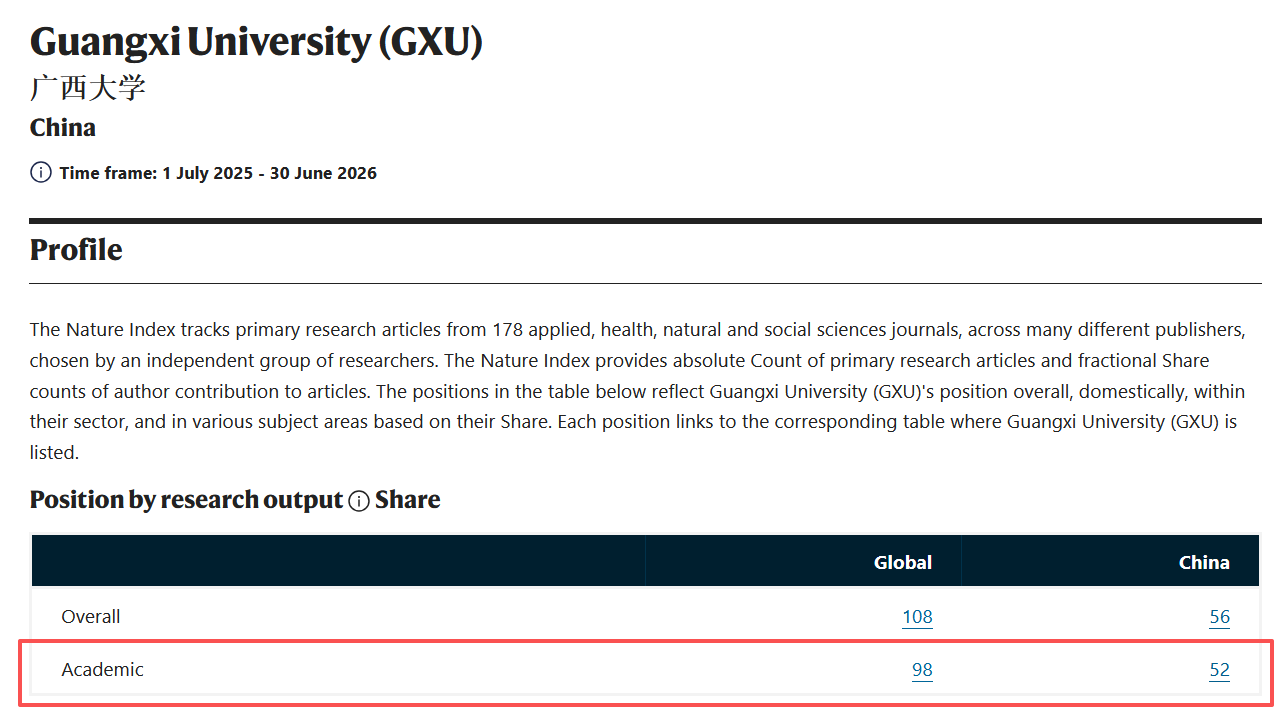
Taking the new development requirements set by the autonomous region as its goal, GXU stays true to its original mission of educating talent for the Party and the country, implements the fundamental task of fostering virtue through education, and benchmarks itself against the “Five Excellences” standards. It pursues deeper comprehensive reform to unleash the internal driving force of institutional development, and uses innovation to drive discipline upgrading, greater platform efficiency and talent capacity building. It works to raise its level of science and technology, accelerate the integrated development of industry, academia and research, and comprehensively improve the quality of talent cultivation, thereby leading the integrated development of education, science and technology, and talent in Guangxi, with its institutional strength and contribution rising steadily.
Adopting a “whole-institution” approach, GXU treats basic research as the foundation of scientific and technological innovation and engineering research, and orients itself toward the global frontiers of science and technology, the main battlefield of the economy, the major needs of the country, and the life and health of the people. It has built high-level platforms for science and technology innovation, steadily advanced organized research, and promoted the deep integration of industry, academia, research and application, providing solid support for original and leading-edge research. It pools efforts to tackle frontier scientific problems and feeds high-level outputs back into research innovation, driving the deep integration of the innovation chain, the industrial chain and the talent chain. A series of landmark achievements have emerged one after another: long-span arch bridge technology remains internationally leading and keeps setting world records; technologies such as near-zero discharge of papermaking wastewater and clean bleaching of pulp remain world leaders; major challenges in sugarcane polyploid genome research have been overcome, with results published in Science, Nature and their subsidiary journals; deep-space exploration results have appeared in Nature twice; and the Guangxi Base of the National Key Laboratory of Critical Metal Beneficiation, Metallurgy and High-Purity Processing has been officially inaugurated.
Looking ahead, GXU will continue to advance the “Double First-Class” initiative, remain firmly committed to the path of a high-level research university, and demonstrate its sense of mission and proactive contribution in supporting high-level self-reliance and strength in science and technology and in serving national strategies and the high-quality economic and social development of Guangxi.
First released in November 2014, the Nature Index mainly tracks author information for research papers published in high-quality natural science journals. It compiles statistics and calculations based on research articles published in 145 leading international academic journals, including the Nature series, Science and Cell, systematically analyzes the high-quality paper output of research institutions worldwide, and on that basis assesses their competitiveness in five core fields: chemistry, earth and environmental sciences, life sciences, health sciences, and physical sciences. The Nature Index has developed into an internationally recognized indicator of the high-quality research output and collaboration of institutions, countries and regions in the natural sciences, and enjoys considerable influence worldwide.

 Home
>
News & Events
>
Events


